
On Grid vs Off Grid vs Hybrid Solar System: The Complete India Guide
Updated September 2026 · A practical, no-jargon explanation of the three rooftop solar system types — how each one works, what it costs per kW in India, subsidy and net metering rules, battery life, and how to choose the right one for a home, shop or factory in Delhi NCR, Haryana, Rajasthan and Uttar Pradesh.
Quick answer
An on grid solar system is connected to the DISCOM grid and exports surplus units through net metering — cheapest per unit, eligible for PM Surya Ghar subsidy, but no backup during a power cut. An off grid solar system runs entirely on batteries with no grid link — ideal where grid supply is absent or unreliable, but 50-80% costlier. A hybrid solar system combines panels, a battery and the grid so you save on bills and still get backup during outages.
1. On Grid (Grid-Tied) Solar System
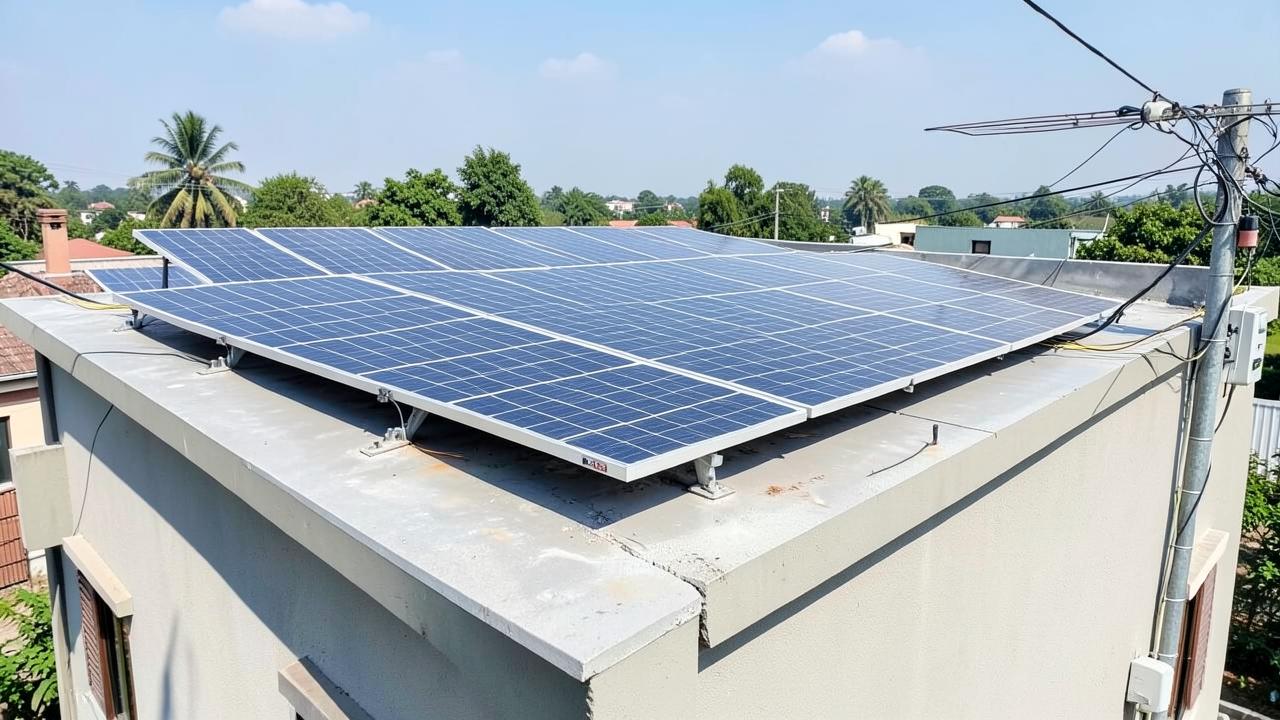
An on grid or grid-tied solar system has three main parts: solar panels, a grid-tie inverter and a bi-directional net meter. Panels generate DC power, the inverter converts it to 230V AC and it is consumed by your appliances in real time. Whatever you do not consume flows back into the DISCOM grid and the net meter records it as export. At the end of the billing cycle your DISCOM — BSES Rajdhani, BSES Yamuna, Tata Power-DDL, DHBVN, UHBVN, NPCL or Jaipur Vidyut Vitran Nigam — bills you only on the net difference between import and export.
There is no battery in an on grid system, which is exactly why it is the cheapest and most efficient option: no storage losses, no battery replacement every few years, and roughly 96-98% inverter efficiency. A 1 kW rooftop system in North India generates about 4-4.5 units per day, or 1,400-1,600 units a year. Typical installed cost is Rs 55,000-65,000 per kWbefore subsidy, and residential systems qualify for the PM Surya Ghar Muft Bijli Yojana subsidy of Rs 30,000 for 1 kW, Rs 60,000 for 2 kW and Rs 78,000 for 3 kW and above. Payback is usually 3-4 years, after which you get 21+ years of near-free electricity.
The one thing an on grid system will not do is run your home during a power cut. Grid-tie inverters have mandatory anti-islanding protection: when grid voltage disappears, the inverter disconnects so that no power is pushed into lines a lineman may be repairing. If outages in your area are rare, this is a small trade-off for the lowest cost per unit.
Advantages
- Lowest cost per kW — no batteries to buy or replace
- Eligible for PM Surya Ghar subsidy up to Rs 78,000
- Net metering credits surplus units against your bill
- Highest efficiency and lowest maintenance
- Payback typically 3-4 years for homes, 2.5-3.5 years for commercial
Limitations
- No power during a grid outage
- Needs DISCOM net metering approval and feasibility clearance
- Sanctioned load and roof area limit the system size
Best for: homes, housing societies, schools, offices, showrooms and factories in Delhi, Noida, Gurgaon, Faridabad, Ghaziabad, Sonipat and Jaipur where grid supply is reasonably stable.
2. Off Grid (Standalone) Solar System
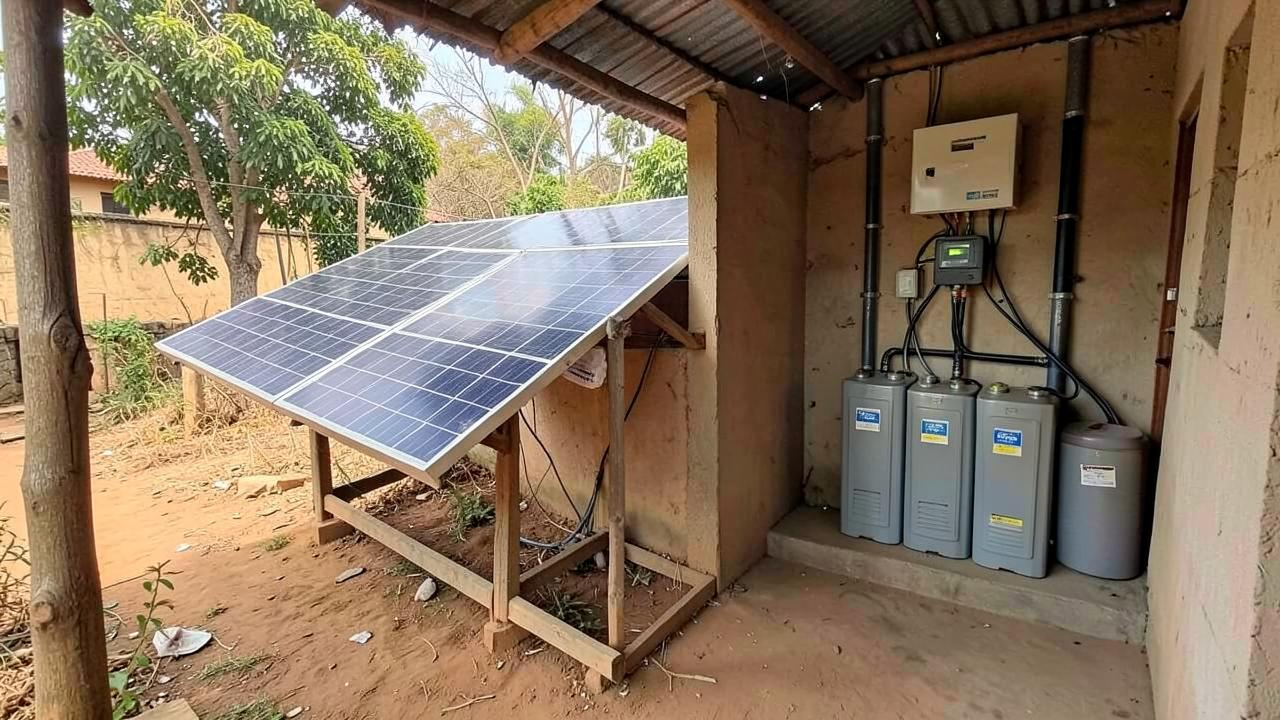
An off grid system is fully independent of the DISCOM. Panels charge a battery bank through a charge controller (MPPT is standard today), and an off-grid inverter draws from the battery to run your loads day and night. Because there is no grid to fall back on, the system has to be sized for the worst case: monsoon days, winter fog in North India and two to three days of autonomy. That usually means 25-40% extra panel capacity and a large battery bank.
Cost lands around Rs 85,000-1,10,000 per kW with tubular lead-acid batteries, and higher with lithium. Batteries are the recurring cost — lead-acid tubular lasts 4-6 years, lithium LFP 8-12 years or about 6,000 cycles. There is no net metering, so any excess generation after the batteries are full is simply wasted unless you shift loads such as water pumps, washing machines or EV charging to daytime. The central PM Surya Ghar subsidy does not apply to pure off grid installations.
Where off grid genuinely wins is anywhere the grid does not reach or cannot be trusted: farm houses and tube wells, telecom towers, construction sites, border and hill locations, mandi cold rooms, and remote resorts. It is also common for solar water pumping under PM-KUSUM.
Advantages
- Complete energy independence — works with no grid at all
- Full backup 24x7, no dependence on DISCOM approvals
- Ideal for farms, tube wells, telecom sites and remote properties
Limitations
- 50-80% costlier than an equivalent on grid system
- Battery replacement cost every 4-6 years (lead-acid)
- No net metering credit; surplus generation is wasted
- Not eligible for the PM Surya Ghar subsidy
3. Hybrid Solar System (Grid + Battery)
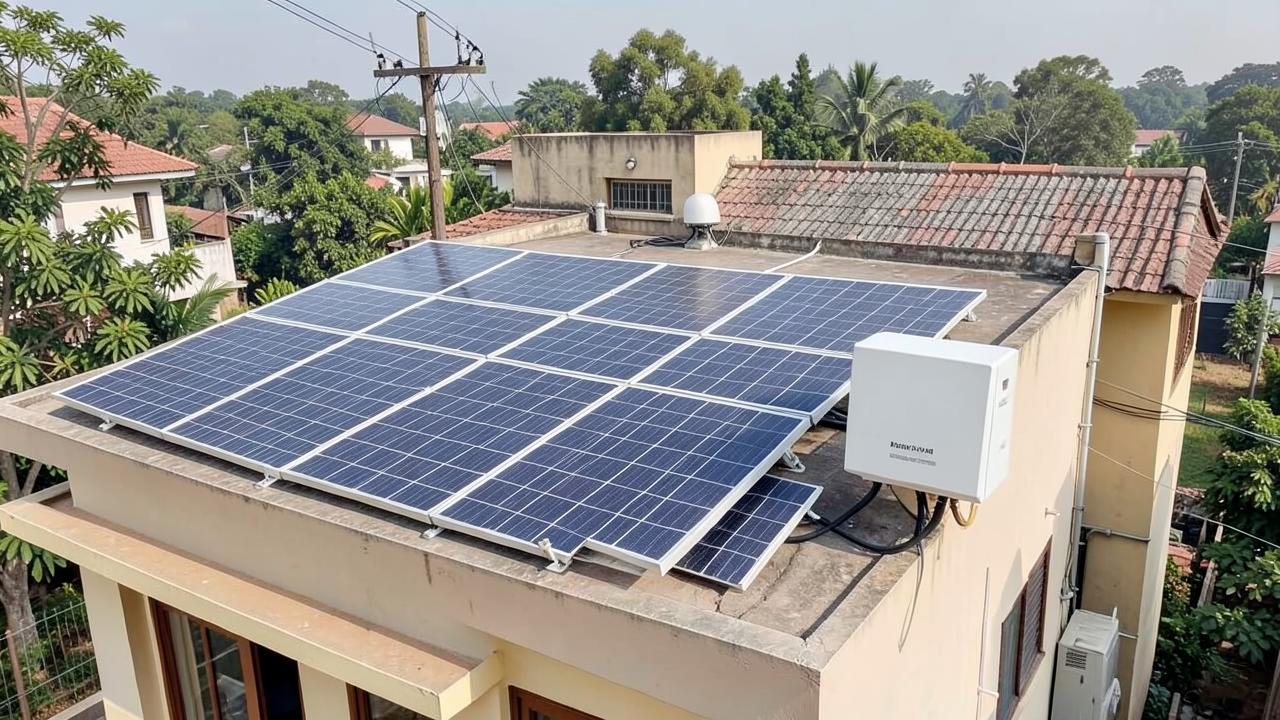
A hybrid system uses a single hybrid inverter that can talk to three sources at once: the solar array, a battery bank and the grid. Its internal logic is priority-based — solar first for live loads, surplus into the battery, and only then export to the grid or import from it. When the grid fails, the inverter switches to backup mode in about 10-20 milliseconds, so lights, fans, Wi-Fi, fridge and even a 1.5-ton inverter AC keep running without a visible flicker.
Typical cost is Rs 90,000-1,20,000 per kW with a lithium battery. Many homes size the backup for essential loads only — a 5 kW system with a 5 kWh LFP battery covers a typical 3BHK evening load for 4-6 hours. Where the DISCOM permits it, the solar portion can still be net-metered and eligible for subsidy; the battery portion is not subsidised. Advanced hybrid inverters also support time-of-day arbitrage for commercial users on ToD tariffs, and generator-compatible input for factories.
Advantages
- Bill savings of an on grid system plus outage backup
- Millisecond changeover — no UPS or separate inverter needed
- Battery can be sized for essential loads only to control cost
- Future-ready for EV charging and time-of-day tariffs
Limitations
- Higher upfront cost than on grid
- Battery replacement after 8-12 years (lithium)
- Slightly lower round-trip efficiency due to storage losses
Best for: villas and homes with frequent outages, clinics, data-sensitive offices, hotels, bakeries, and any load that cannot afford downtime.
On Grid vs Off Grid vs Hybrid: Comparison Table
| Parameter | On Grid | Off Grid | Hybrid |
|---|---|---|---|
| Battery | No | Yes (mandatory) | Yes (optional size) |
| Grid connection | Yes | No | Yes |
| Backup during power cut | No | Yes | Yes |
| Cost per kW (approx.) | Rs 55,000-65,000 | Rs 85,000-1,10,000 | Rs 90,000-1,20,000 |
| PM Surya Ghar subsidy | Yes, up to Rs 78,000 | No | On solar portion only |
| Net metering | Yes | No | Usually yes |
| Maintenance | Lowest | Highest (batteries) | Moderate |
| Payback period | 3-4 years | 6-9 years | 5-7 years |
| Best suited to | Homes & businesses on a stable grid | Farms, remote sites, tube wells | Homes/offices with frequent outages |
How to Choose the Right Solar System
Stable grid, want max savings
Choose on grid. Add net metering and claim the PM Surya Ghar subsidy. Fastest payback.
No grid or unreliable supply
Choose off grid, sized for 2-3 days of autonomy with MPPT charge control.
Grid available but frequent cuts
Choose hybrid with a lithium battery sized for essential loads.
Sizing is simple: divide your average monthly units by 120 to get the kW needed in North India. A 300-unit monthly bill needs roughly 2.5 kW; 600 units needs about 5 kW. Each kW needs about 80-100 sq ft of shadow-free roof. Use our solar savings calculator to check savings and payback for your own bill.
Frequently Asked Questions
What is the difference between on grid, off grid and hybrid solar systems?
An on grid solar system works with the DISCOM grid and exports extra units through net metering, but shuts down during a power cut. An off grid solar system runs only on batteries and has no grid connection. A hybrid solar system combines both — it uses the grid, charges a battery and keeps your home running during outages.
Which solar system is best for a home in Delhi NCR?
For most homes in Delhi, Noida, Gurgaon and Faridabad an on grid rooftop solar system is best because the grid supply is reliable, net metering is available and the PM Surya Ghar subsidy of up to Rs 78,000 applies. If you face frequent outages, a hybrid system with a 5 kWh lithium battery is the better fit.
Is subsidy available on off grid and hybrid solar systems?
The PM Surya Ghar Muft Bijli Yojana subsidy is available only on grid-connected residential rooftop solar with net metering and approved ALMM panels. Pure off grid systems and the battery portion of a hybrid system are not covered by the central subsidy.
How much does a 5 kW solar system cost in India?
A 5 kW on grid rooftop solar system typically costs Rs 2.6-3.2 lakh before subsidy, an off grid 5 kW system with batteries Rs 4-5.5 lakh, and a hybrid 5 kW system with a lithium battery Rs 4.5-6 lakh, depending on panel, inverter and battery brand.
Do on grid solar systems work during a power cut?
No. For safety, a grid-tied inverter switches off during an outage so that power is not fed back into lines where linemen may be working. Only hybrid or off grid systems with battery backup keep supplying power during a blackout.
How long do solar batteries last?
Lead-acid tubular batteries last about 4-6 years, while lithium-ion (LFP) batteries last 8-12 years or roughly 6,000 cycles. Lithium costs more upfront but is usually cheaper per unit stored over its life.
What is net metering and why does it matter?
Net metering is a DISCOM arrangement where a bi-directional meter records the units you export to the grid and offsets them against the units you import. Your bill is calculated on the net difference, which is what makes on grid solar pay back in 3-4 years.
Can I convert my on grid solar system into a hybrid system later?
Yes. You can add a hybrid inverter and battery bank later, or install an AC-coupled battery alongside the existing grid-tied inverter. Planning DC cable size and space at the time of the first installation makes the upgrade cheaper.
Explore more
Not sure which system suits your roof?
Book a free solar survey — we check your roof, bill and DISCOM feasibility, then recommend on grid, off grid or hybrid with exact costs and subsidy.